
Values: The One Conversation Every Expecting Parent Should Have
There is no shortage of things people tell you to do before a baby arrives. Buy this. Research that. Take this class. Read this book. Build this registry. Tour those daycares.
And somewhere in the middle of all that noise, the most important conversation gets completely skipped.
Not the conversation about gear. Not the birth plan. Not even the money talk — though that one matters too. The conversation I'm talking about is the one about who you want to be as parents. Your values. The principles that will guide every decision you make, from the small and daily to the ones that keep you up at night.
If you do one thing to prepare before this baby arrives, make it this.
Why Values — and Not Methods — Are What Actually Matter
The parenting industry is built on methods. Sleep training. Attachment parenting. Montessori. Baby-led weaning. Schedules versus feeding on demand. The list of approaches you can choose from — and feel guilty about not following correctly — is truly endless.
Here's the problem with starting with methods: you haven't decided what you're trying to achieve yet. Methods are tools. Values are the destination. And if you don't know where you're going, no tool is going to reliably get you there.
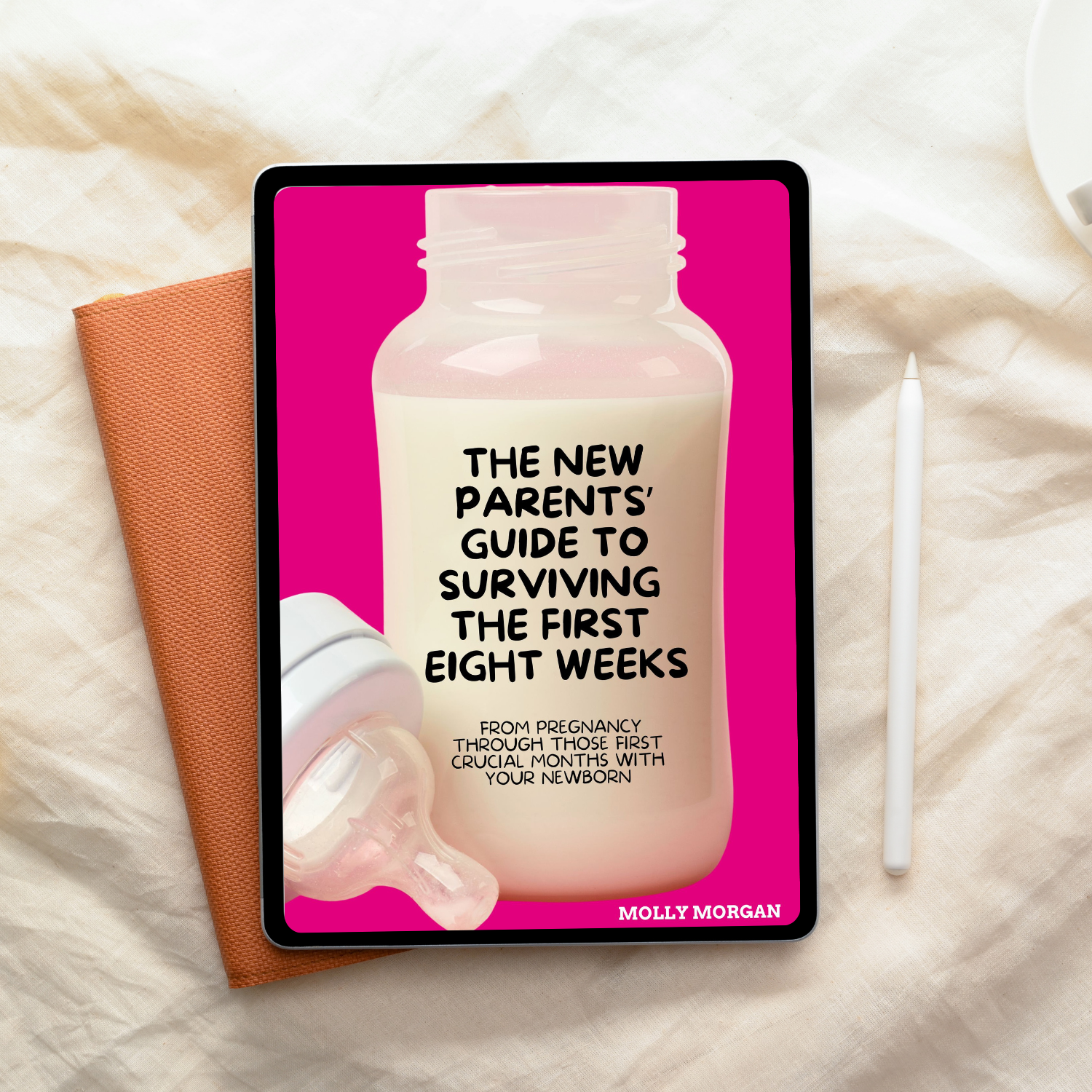
The book that tells you what actually matters — and gives you permission to ignore everything else. The course delivers your guidance when you need it. The book gives you the full picture whenever you want it. Some people like having both — to read ahead, to hand to a partner who isn't on the course, or just to have something to hold.
Instant access to the bestselling guide for first-time parents covering pregnancy, the newborn stage, and everything in between. No fear-mongering, no information overload. Just honest, practical support from a mom who has been through it.
This listing is for the digital download. You'll receive access immediately after purchase. Prefer a paperback? Grab it on Amazon.
Parenting values aren't rules or routines. They're the principles that tell you what kind of parent you want to be at your core — especially when things get hard. And things will get hard. When you're sleep-deprived and your baby won't stop screaming and you haven't showered and you and your partner are both at the end of your rope, you will not remember what the parenting book said. But you will remember what you care about. Your values are what guide you when nothing else does.
The 3 AM Moment That Made This Real for Me
I want to tell you how my husband and I came to have this conversation — because it didn't happen thoughtfully during a quiet pregnancy evening. It happened in crisis.
Our baby was seven days old. It was 3 AM, and he was screaming. I was desperately trying to get him to latch, sobbing, while my husband stood next to me trying to help but couldn't. We were all miserable — me, my husband, the baby. All of us.
At 5 AM, we gave him a little formula. He instantly calmed down.
And I remember thinking: I just let my baby scream for hours without being able to meet his needs. I met him with anger and frustration when all he was asking for was food. All because I had been told that breast is best — and I believed the noise over my own instincts.
The experience felt completely out of alignment with something I couldn't quite name yet, because we hadn't named it. We hadn't said our values out loud. So I kept going, because there was so much noise about what a good mother should do.
It didn't get better. My husband and I were exhausted. Our mental health suffered. Our son was hungry and upset. Our energy toward him was anxious and strained. We supplemented occasionally with formula just to keep us all sane, but nobody felt good about any of it.
Finally, after a call with my therapist, I realized what was actually happening: in service of optimizing what I fed my baby, I was not being the parent I wanted to be for him. I was not meeting him with love consistently. I was not listening to him when he expressed his needs.
That's when my husband and I sat down and had the conversation we should have had months earlier.
The Question That Changes Everything
We asked ourselves: Can we be the parents we want to be for our son and breastfeed?
And to answer that, we had to figure out what "the parents we want to be" actually meant.
What we landed on was this: we felt most like the parents we wanted to be when we could consistently meet our son with love when he expressed a need. That was the core of it. Not a rule, not a method — a value. We wanted to meet him with calm, loving energy as often as possible.
It sounds simple. But babies are constantly expressing needs, often by screaming bloody murder at you. Meeting that with a calm, loving presence takes it to another level entirely. And we knew we couldn't do it consistently on no sleep, running on anxiety and guilt.
Knowing our value made the decision clear. We stopped breastfeeding and switched to formula. I cannot overstate how hard that was. The world practically equates breastfeeding with being a good mother. It took three days of waffling before we felt settled in the choice.
But we were settled — because we had done the work. Our value gave us a compass, and we used it.
Because our core value was so focused on the present, it also meant letting go of some of the future-focused parenting "shoulds." We didn't stress about getting the perfect Montessori-themed toys. We let the baby nap on us when he needed to. We trusted that the future would work itself out — that our child would be smart, healthy, and a good sleeper regardless of early decisions. What we prioritized above everything else was for him to know that he is loved for exactly who he is, in each moment.
What Parenting Values Actually Are
Parenting values are not rules. They're not methods. They're not the specific things you will or won't do. They're the principles underneath all of that — the why that guides the what.
They sound like this:
"I want to be fully present when my child needs me."
"I want to take care of my own wellbeing so I can show up better for my child."
"I want to create a safe space for my child to express their emotions."
"I want to maintain a strong partnership with my co-parent so our decisions feel consistent."
"I want my child to know they are loved for exactly who they are."
"I want to model the behaviors and values I hope they'll carry."
"I want to make decisions based on my child's actual needs, not fear or guilt."
Notice what those aren't: a list of dos and don'ts. They're about who you want to be. And that distinction matters enormously when you're in the thick of it and have to make a decision fast, without time to consult a book or a Facebook group.
Why You Need to Have This Conversation With Your Partner
You and your partner were raised by different people, in different ways. You have different fears. Different defaults. Different ideas of what "good parenting" looks like that were shaped long before you ever met each other.
The goal of this conversation isn't to arrive at identical values — it's to understand where each of you is coming from, find your common ground, and figure out how you'll navigate things when your instincts diverge.
Without this conversation, you'll end up:
Making decisions reactively instead of intentionally
Fighting about things you didn't know you disagreed on
Parenting out of guilt and anxiety instead of from a grounded place
Using methods that don't actually reflect what either of you cares about
With it, your disagreements shift from "who is right" to "how do we honor what we both value." That's a completely different kind of conversation.
How to Actually Have It
Find a quiet moment — dinner, a walk, sitting on the couch. Both of you answer these questions individually first, then discuss them together.
Start here:
What do we want our child to feel when they're with us?
What matters most to us about how we show up as parents?
When we imagine our family a few years from now, what does it feel like?
Then go deeper — individually:
How were you parented? What did your parents do well? What do you want to do differently? What fears or patterns from your own childhood might show up?
What are you most scared about as a parent?
What does "being a good parent" mean to you — not what you think you're supposed to say, but what actually matters to you?
Complete this sentence: "I will feel like I'm succeeding as a parent if..."
What do you need from me as your co-parent?
Then share your answers and talk about:
Where do our values align? This is your foundation.
Where do they differ? This isn't a problem to fix — it's just information.
What are our absolute non-negotiables? (Safety, major philosophies, things you will not bend on. These should be few but clear.)
How will we make decisions when we disagree?

All the answers you need as a first-time parent — none of the noise, overwhelm, or 2 AM panic searches. We'll cover everything from what is actually going on in your body, how to navigate pregnancy with your sanity intact, the conversations and date nights you should be having with your partner, and all the baby-care support you need to get through those first two months with your newborn.
All the answers you need as a first-time parent — none of the noise, overwhelm, or 2 AM panic searches. We'll cover everything from how to show up for your partner during pregnancy, what is actually going on in their body, the conversations and date nights you should be having, and all the baby-care support you need to get through those first two months with your newborn.
Values Are Also a Practical Tool
This isn't just a meaningful exercise. It's genuinely useful for the day-to-day decisions of new parenthood — including the ones you haven't thought of yet.
Once you know your values, they do the work for you.
If one of your values is "be fully present," that might shape where you spend money (house cleaner, meal delivery, night doula — support that frees you up to actually be there), how you structure your evenings, and how you respond when the baby cries.
If one of your values is "take care of my own wellbeing so I can show up better," that gives you permission — real permission — to prioritize sleep, to ask for help, to not feel guilty about handing the baby to someone else so you can rest. It's not selfish. It's aligned with what you decided matters.
If one of your values is "maintain a strong partnership," you'll make time for that connection even when it's inconvenient, because you've already agreed it's a priority — not something to get to when you have more energy (you won't).
Values also make your registry make sense. Instead of buying everything on the internet's list, you're buying for the parents you actually intend to be.
Write It Down
After your conversation, actually write down:
Your 3–5 shared values as parents
How you'll approach decisions when you disagree
Your non-negotiables
What you each need from the other as co-parents
Put it somewhere you can find it. Because the moment you need it most — at 3 AM, when you're both exhausted and fighting about something that feels enormous in the moment — is exactly when you won't be able to reconstruct it from memory. Having it written down means you can come back to it. You can say: what do we both value here, and how do we honor that?
This is also a living document. What feels most important before the baby arrives might shift once you're actually in it. Plan to revisit the conversation after the first week, after the first month, after three months. Ask each other: are these still our values? What's changed?
The Most Important Thing
There is so much noise about what a good parent does. There are equal parts cheering and shaming for the exact same parenting decisions, which should tell you something: there is no universally right way to raise a child. There is only the right way to raise your child.
Shame is one of the most powerful currencies in the parenting industry. Advertisers use it. Content uses it. Well-meaning family members use it. Your values are your protection against all of it. They let you filter the noise and make decisions from a grounded place rather than a frightened one.
You picked this. This baby picked you. And if you're reading this, it tells me that you want to show up for them. That's already the most important thing.
The values conversation is how you figure out what "showing up" means for your family specifically. Have it before the baby arrives, while you can think clearly. Revisit it when life gets hard. Use it as your compass.
You are enough. You can do this.
Want week-by-week guidance on what to think about when — including exactly when and how to have the money conversation — without the overwhelm? That's what the Need-to-Know course is built for. [Join us here.]
Featured Resources
The book that tells you what actually matters — and gives you permission to ignore everything else. The course delivers your guidance when you need it. The book gives you the full picture whenever you want it. Some people like having both — to read ahead, to hand to a partner who isn't on the course, or just to have something to hold.
Instant access to the bestselling guide for first-time parents covering pregnancy, the newborn stage, and everything in between. No fear-mongering, no information overload. Just honest, practical support from a mom who has been through it.
This listing is for the digital download. You'll receive access immediately after purchase. Prefer a paperback? Grab it on Amazon.
All the answers you need as a first-time parent — none of the noise, overwhelm, or 2 AM panic searches. We'll cover everything from what is actually going on in your body, how to navigate pregnancy with your sanity intact, the conversations and date nights you should be having with your partner, and all the baby-care support you need to get through those first two months with your newborn.
All the answers you need as a first-time parent — none of the noise, overwhelm, or 2 AM panic searches. We'll cover everything from how to show up for your partner during pregnancy, what is actually going on in their body, the conversations and date nights you should be having, and all the baby-care support you need to get through those first two months with your newborn.