
The Money Conversation Every Expecting Couple Needs to Have
Everyone has an opinion about what you need to buy before the baby arrives. The crib, the stroller, the monitor, the sound machine, the special swaddles. The list is endless and grows by the day.
Here's what nobody's telling you to do: sit down with your partner and actually talk about money.
Not in a vague "we should probably figure out finances" way. A real conversation — about what things are going to cost, what you actually need, and what kind of parents you want to be. Because if you don't have this conversation now, while you can think straight, you will have it later when you're both sleep-deprived, stressed, and resentful. And that version goes much worse.
The good news: you have more control over this than the baby industry wants you to believe.
First: Understand What's Actually Expensive About Having a Baby
Hint — it's not the cute stuff. The onesies and the toys and the nursery décor are the least of it. What's actually expensive is the infrastructure around having a baby:
Medical costs — birth, postpartum care, pediatrician visits
Childcare — daycare, a nanny, or the income you lose if one of you doesn't return to work
Parental leave — and what that gap in income actually looks like for your household
Postpartum support — doulas, house cleaners, meal delivery, the things that keep you functional
The hidden costs — more food delivery, more convenience purchases, more of everything, because you have no time

All the answers you need as a first-time parent — none of the noise, overwhelm, or 2 AM panic searches. We'll cover everything from what is actually going on in your body, how to navigate pregnancy with your sanity intact, the conversations and date nights you should be having with your partner, and all the baby-care support you need to get through those first two months with your newborn.
Most couples spend months agonizing over which stroller to buy and never once look at what their childcare will actually cost them. Daycare costs vary wildly by location, but in many cities infant care runs $1,500–3,000+ per month — sometimes more than rent. A nanny can be even higher. For some families, one partner's entire salary goes straight to childcare.
You need to know your number before you need it.
Start a Baby Fund — Now
Before you get into the hard conversations, here's one practical step you can take immediately: open a separate account and call it your baby fund. Set up automatic transfers from each paycheck — even if it's just $50 each. Start the habit now.
Nine months of saving adds up. And having a separate pool of money that's specifically for baby-related expenses does a few things: it cushions unexpected costs, it keeps baby spending visible and trackable, and it creates a shared resource neither of you feels guilty tapping. Emergency 2 AM purchase? Baby fund. Childcare more than expected? Baby fund. Night doula for your sanity? Baby fund.
Start now.
The Conversation to Have: Five Parts
This isn't one quick chat — it's a framework for thinking through your situation together. Grab your partner, clear some time, and work through this.
Part 1: What Are Your Values as Parents?
This sounds philosophical but it's actually the most practical starting point, because your values will make your spending decisions for you.
Ask each other: What kind of parents do you want to be? What matters most about how you show up? Some examples to get you started:
"I want to be fully present when my child needs me."
"I want to protect my own wellbeing so I can show up better."
"I want to maintain a strong partnership."
"I want our basic needs — sleep, food, cleanliness — to be met."
Write these down. You'll use them to decide where money actually goes.
Part 2: Be Honest About Your Current Struggles
Here's a truth that doesn't get said enough: you are not going to become magically better at household management when a baby arrives. If you already struggle with something, it will get harder when you're sleep-deprived and have a newborn.
So be honest with each other, right now, about what's already hard:
Sleep: How much do you each need to function? What happens to you when you don't get it?
Laundry: Is it already a source of stress? Does it pile up?
Cooking: Do you already order out more than you'd like? How important is eating well to your mental health?
Cleaning: Does a messy house affect your mood? Are you already barely keeping up?
Pets: If you have animals, who handles them now? What will that look like with a newborn?
This isn't about judging each other. It's about designing your support system around who you actually are, not who you imagine you'll somehow become under more pressure.
Part 3: What Infrastructure Could Actually Help?
Based on what you just identified, what services or support would make your life manageable in those first months?
Consider:
A night doula (one or two nights a week can be genuinely life-changing — more on this in a minute)
A house cleaner (a weekly or bi-weekly reset so you're not drowning)
A dog walker (if you have pets that need attention you won't be able to give)
Food delivery or a meal service (especially for the first six to eight weeks)
A postpartum doula (daytime support, help with feeding, someone to answer your questions, someone to hold the baby so you can shower)
A babysitter fund (for when you need a break and your relationship needs tending to)
Yes, this costs money. But here's the real math: the cost of support is high. The cost of not having support — in terms of your mental health, your relationship, your ability to function — is higher.
Part 4: The Money Reality Check
Now look at actual numbers together:
What is our current monthly budget?
How much are we saving each month, and can we set up automatic transfers to a baby fund?
What is our childcare plan if we're both returning to work, and what will it cost?
What's our parental leave situation? Is any of it unpaid, and what does that gap look like?
What can we cut or reduce to make room for the support we actually need?
Can we use our registry to ask for cash toward infrastructure instead of just stuff?
That last one is worth sitting with. If you use a registry like Babylist, you can add cash funds — for a night doula, house cleaning, postpartum support, meal delivery. Your family and friends want to help and they often don't know how. Telling them exactly what would help is a gift to everyone.
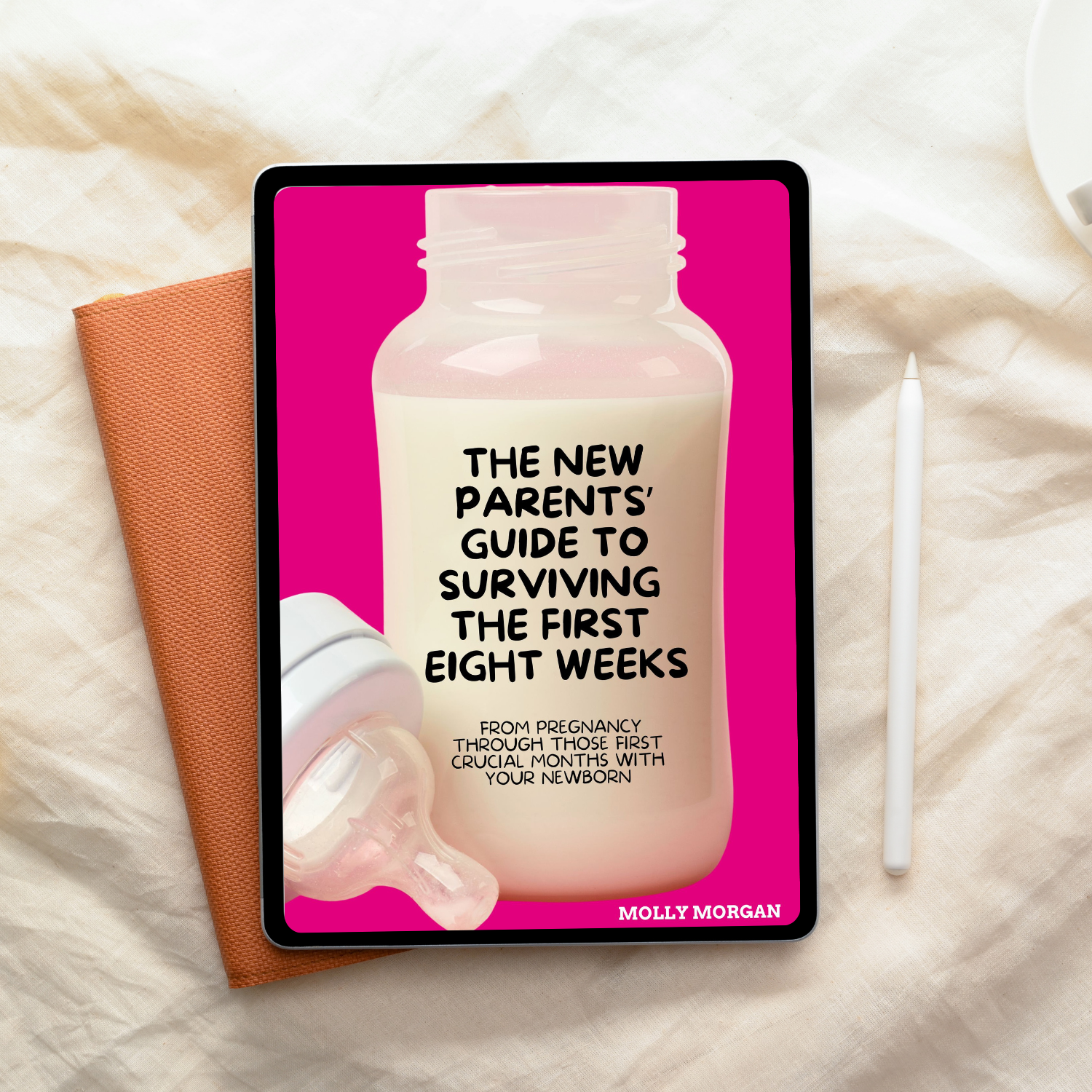
The book that tells you what actually matters — and gives you permission to ignore everything else. The course delivers your guidance when you need it. The book gives you the full picture whenever you want it. Some people like having both — to read ahead, to hand to a partner who isn't on the course, or just to have something to hold.
Instant access to the bestselling guide for first-time parents covering pregnancy, the newborn stage, and everything in between. No fear-mongering, no information overload. Just honest, practical support from a mom who has been through it.
This listing is for the digital download. You'll receive access immediately after purchase. Prefer a paperback? Grab it on Amazon.
The Conversation That's Bigger Than Money: Should One of You Leave Your Job?
This is where a lot of couples do the math, see that one salary roughly equals the cost of childcare, and assume the answer is obvious. It is not obvious. The math is just one input, and treating it as the whole decision is one of the most common mistakes expecting parents make.
Whether one partner leaves their job — or stays home long-term — is not primarily a financial question. It is a question about identity, career trajectory, mental health, relationship dynamics, and what each of you actually wants. Those things are not line items on a spreadsheet, but they are every bit as real.
Here's what the financial math misses:
Career gaps have long-term consequences. Stepping out of the workforce for even one or two years can affect your earning potential, your professional network, your advancement opportunities, and your sense of momentum — sometimes for a decade or more. That's not a reason to never do it, but it needs to be part of the conversation honestly, not minimized as "just a few years."
Work is often tied to identity. For many people, their job is not just income — it's how they structure their day, where they find intellectual stimulation, how they maintain friendships, and a core part of how they see themselves. Removing that overnight, while simultaneously caring for a newborn around the clock, is a massive identity disruption. Some people thrive in it. Others don't — and find themselves isolated, depleted, and quietly resentful in ways they didn't anticipate. Neither response is wrong. But you have to be honest about which person you actually are, not which person you think you should be.
Staying home is real work — and it needs to be treated that way. If one partner stays home, that is not a free pass for the other to disengage from household and childcare responsibilities when they're home. The stay-at-home parent is not on call 24 hours a day while the working partner clocks off at 5 PM. That dynamic breeds resentment fast. If you choose this arrangement, you need to explicitly agree on what the division of labor looks like during evenings and weekends, when the stay-at-home parent gets actual breaks, and how you'll handle it on the days that are simply too hard.
The guilt will be there regardless of what you choose. Going back to work means guilt about leaving the baby. Staying home means guilt about the career, the lost income, the identity. This is not a reason to avoid the decision — it's just worth naming honestly so it doesn't hit you by surprise and make you second-guess a choice that was actually right for you.
So how do you actually make this decision?
Start not with the spreadsheet but with each other. Before money enters the conversation, ask: What do each of us actually want? Setting aside the finances, the expectations, what other people think we should do — what do we want?
Then: Given our financial reality, our values, and what we each want — what makes sense for our family?
Watch out for these red flags in the conversation:
"Well, you make less money, so you should stay home." This dismisses the non-financial value of someone's work — their career trajectory, their sense of self, their benefits, their professional relationships. Salary is not the only thing a job provides.
"It's just for a few years." Be honest about the real cost of that. Don't minimize it to make the decision easier.
"But don't you want to be with the baby?" Guilt is not a basis for a major life decision. Some people genuinely want to stay home. Others need their work to be well. Both are true and neither is wrong.
If one partner does stay home, make sure it feels like a real choice — not a default that happened because the math made it seem inevitable, or because one person felt too guilty to say they didn't actually want to. Resentment that builds from a decision that wasn't truly made together is very hard to recover from.
And if both of you go back to work: talk now about the logistics that become flashpoints later. Who handles daycare communication? Who takes the sick days when the baby can't go in — because babies in daycare get sick a lot, roughly 8–12 times in that first year? If it defaults to the same person every time, that person's career suffers. Decide this consciously, not by default.
There is no universally correct answer here. There is only what works for your specific family — arrived at honestly, together, with both people's needs on the table.
Part 5: Make the Trade-offs Consciously
You can't afford everything. Nobody can. So you have to make choices — and making them based on your values is how you make them well.
If one of your values is being present and calm with your baby, then you probably prioritize things that protect your sleep and reduce household stress. If one of your values is maintaining your physical health, you might prioritize time and budget for exercise and good food.
What you almost certainly don't need to prioritize: all the enrichment gear the internet is selling you. Einstein didn't have contrast cards and he managed fine. Your baby needs you — fed, rested, present, and sane. That's where the money conversation should point.
A Story About Priorities
When I was going through this process myself, I genuinely didn't think we could afford a night doula. It felt like a luxury — something other people did.
But after working through the values and infrastructure conversation, I got clear on something: my top value was being present with calm, loving energy. And I cannot do that on zero sleep. I'm not wired that way.
So I made a decision. I sold the campervan I had converted to help cover the cost of a night doula and daycare.
The doula would arrive at 11 PM and leave at 6 AM. My husband would bring the baby to her at eleven, and I'd take him back at six. At least one night a week, I slept a full, uninterrupted eight hours.
Was it worth selling the campervan? Absolutely. Because I knew what I needed to show up as the parent I wanted to be, and I made the financial decision to match.
That's what this conversation is really for.
The Permission You Need
You don't have to do this alone. You don't have to be superhuman. You don't have to white-knuckle through the hardest weeks of your life and prove you didn't need help.
Getting support isn't a luxury. It's a necessity if you want to show up as the parent you actually want to be. And asking for help isn't weakness — it's the smartest thing you can do with this window of time before the baby arrives.
Have the conversation this week. Write down your top three infrastructure priorities. Start the baby fund. Look at the real numbers. And before the spreadsheet, ask each other what you actually want.
You have more control over this than you think — but only if you look.
Want week-by-week guidance on what to think about when — including exactly when and how to have the money conversation — without the overwhelm? That's what the Need-to-Know course is built for. [Join us here.]

All the answers you need as a first-time parent — none of the noise, overwhelm, or 2 AM panic searches. We'll cover everything from how to show up for your partner during pregnancy, what is actually going on in their body, the conversations and date nights you should be having, and all the baby-care support you need to get through those first two months with your newborn.
Featured Resources
The book that tells you what actually matters — and gives you permission to ignore everything else. The course delivers your guidance when you need it. The book gives you the full picture whenever you want it. Some people like having both — to read ahead, to hand to a partner who isn't on the course, or just to have something to hold.
Instant access to the bestselling guide for first-time parents covering pregnancy, the newborn stage, and everything in between. No fear-mongering, no information overload. Just honest, practical support from a mom who has been through it.
This listing is for the digital download. You'll receive access immediately after purchase. Prefer a paperback? Grab it on Amazon.
All the answers you need as a first-time parent — none of the noise, overwhelm, or 2 AM panic searches. We'll cover everything from what is actually going on in your body, how to navigate pregnancy with your sanity intact, the conversations and date nights you should be having with your partner, and all the baby-care support you need to get through those first two months with your newborn.
All the answers you need as a first-time parent — none of the noise, overwhelm, or 2 AM panic searches. We'll cover everything from how to show up for your partner during pregnancy, what is actually going on in their body, the conversations and date nights you should be having, and all the baby-care support you need to get through those first two months with your newborn.